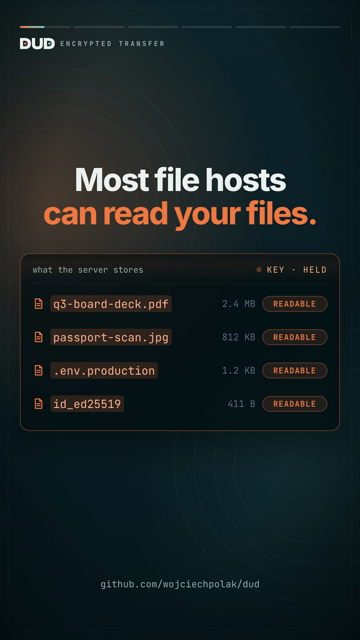
dud --tui, a full-screen client with the same main actions as the interactive menu: send, receive, git, peers, status, setup, and tools. Support peer and dead drop transfers, Git checkpoints, delivery status, encryption keys, configuration inspection, and scoped local-state management. Existing CLI commands and the interactive menu retain their behavior.broadsheet, the front page of a newspaper; phosphor, a green terminal that prints on green-bar paper in light mode; riso, a risograph-printed zine; and dotfiles, a riced terminal, with tmux's status line on top and the entries as vim buffers. They load nothing from other sites: their text is set in system fonts, and riso carries Anton (SIL Open Font License) for its headings as a WOFF2 of its own. On a wide screen broadsheet lays the stream out as a front page: the lead story across, the others in two ruled columns. default stays the theme a site starts with.aria-current="page", which a screen reader announces and a theme can draw.THEMES picks the themes a visitor can switch between, and DEFAULT_THEME the one a visitor starts with, from the environment. A theme of your own in RUN_DIR/static/themes/<name>/ needs only its name in THEMES: its pipeline bundle is made for it. manage.py check reports an empty THEMES, a name a theme cannot go by and a DEFAULT_THEME that THEMES lacks.default theme, a sidebar taller than the window, as one with many services and lists is, hid its bottom, "Change theme" among it, until the stream ended. It is now pinned by its bottom, so all of it scrolls into view; one that fits stays pinned by its top as before.http://: in the Atom and JSON feeds, in the friends' login and in the OAuth redirect URI shown in settings. SECURE_PROXY_SSL_HEADER=1 makes Django take a request that the proxy marks with X-Forwarded-Proto: https for an HTTPS one. The bundled nginx template passes that header on, and docker-compose.yml passes the setting to the app.admin. create_initial_user takes it from INITIAL_ADMIN_PASSWORD or generates one and prints it once, so a Docker Compose start still needs no setup. An existing account that still has admin gets a new password the same way at the next start. Until the forced password change is done, the admin site is closed too.go.mod, preventing analyzer export-data incompatibilities when the host Go version is newer.18–24 July, instead of the mode.I built DUD for encrypted handoff of files, messages, and Git data. It supports dead drops or paired devices, with Cloudflare or self-hosted backends. Start here:
https://github.com/wojciechpolak/dud
#Privacy #Encryption #SelfHosting #OpenSource
dud doctor, dud capabilities, and their JSON output. Peer servers publish it on capability discovery without changing the deterministic capability document.gocyclo, errcheck, deadcode, goimports, govulncheck, and staticcheck, plus a multichecker bundling the golang.org/x/tools analyzers that go vet leaves off. They are declared in tools/, a module separate from the two that ship, so nothing they depend on reaches the client binary, and tools/go.sum fixes the version of each one. npm run analyze:go runs them; the analyzers that report nothing block through npm run check, and the rest report on pull requests.npm run check:tidy, which fails if go mod tidy would change any module, so the pinned analyzer set always matches what the build uses.headV2ChunkUploadPart, a chunk upload probe nothing called. Its removal makes deadcode report nothing, so that analyzer now blocks.tar.Header.Xattrs and matching the deprecated tar.TypeRegA when inspecting a collection archive. An extended attribute arrives as a SCHILY.xattr.* record that the record check already rejects, and the reader reports a pre-POSIX regular file as tar.TypeReg, so both reads were redundant.govulncheck from the pinned tools module instead of installing it at job time, so the scanner that runs is the version tools/go.sum hashes..github/supported-versions.json, not the client module alone.staticcheck to a blocking analyzer. ST1005 is off. Every error string it reported opens with the proper noun "Git", which the check reads as a sentence opening.errcheck to a blocking analyzer. Every deferred Close, Remove, and terminal restore whose failure cannot change the result now discards its error explicitly. -blank and -asserts are off: a _ = here marks a discard the author chose, and a bare type assertion reads a field whose type a validator has already checked or whose type the standard library documents.dud peer resume PEER and follow-up dud receive PEER commands to sequence-gap errors, and warn that the sender must resend skipped deliveries.dud flush, dud test, and dud upload --json pass a response body through to standard output, and a short write there exited 0 as though the whole body had been written.https:// link, no dead Flash media. Entries that only change markup can be applied at once. A video the provider no longer has can be replaced with another copy, found from the review page.data-id instead of id. A user-scripts.js that looks a player up by id should use data-id.dproxy is my HTTPS and WebSocket proxy over an ECH-protected WSS relay. Application TLS stays end to end. Repo and setup: https://github.com/wojciechpolak/dproxy
#Privacy #Networking #SelfHosting
Discreet HTTPS and WebSocket proxy over an ECH-protected WSS relay, preserving end-to-end application TLS. - wojciechpolak/dproxy
v1.4 tag (March 2021). This is a large span of work, so only the significant changes are listed.share.joinmastodon.org, which asks for the reader's server.Retry-After from the remote wins. A failure that retrying cannot fix waits at least a day. The status tab shows how many times in a row a service has failed. FETCH_RETRY_BASE_SEC and FETCH_TERMINAL_DELAY_SEC set the delays.FETCH_JOB_TIMEOUT_SEC (15 minutes by default). A service whose fetch hangs no longer stops the worker from fetching the others; it is recorded as timed out and retried with backoff.--uploads-list-orphans (also manage.py worker_cleanup) reports uploaded files that no entry, Media row or template of the owner uses, such as the files of a deleted selfpost. It only lists them: gLifestream never moves or deletes an upload. The worker runs the report monthly and prints it to its log, with a warning when most uploads look unused, which points to a database that does not match MEDIA_ROOT.docs/ARCHITECTURE.md, describing the module layers, what each module owns, and how requests, imports and WebSub pushes move through the code. The layers are checked with import-linter (uv run lint-imports), in ./scripts/check and in CI.INSTALL.md covers backups, upgrades with and without Docker, systemd units for the web process and the worker, and the worker's maintenance schedule (WORKER_MAINTENANCE_JOBS), which replaces the crontab older versions needed../scripts/bootstrap, a one-command local setup. It installs the dependencies, writes a .env with random secrets, migrates the database, compiles translations, creates the media directories and the initial admin user. It is safe to run again and never overwrites an existing .env.manage.py load_initial_data loads it with the starting services into an empty database, both in Docker and in ./scripts/bootstrap; --no-welcome leaves the entry out. A new installation also gets a starting About box and copyright footer (user-about.html, user-copyright.html in run/templates/). In the Compose stack FEED_AUTHOR_NAME defaults to "gLifestream" instead of "YOUR NAME".Released wojciechpolak/obsidian-daily-echoes 1.1.0
Changed
client_pins requires a client certificate whose SPKI digest is in that set, verified during the handshake before HELLO is read and metered by the authentication rate limiter. Clients set client_identity_file; the identity is created on first use with owner-only permissions and its client_pin is printed at startup. The shared token remains mandatory in every mode, the dproxy/1 protocol is unchanged, and a remote without client_pins behaves exactly as before.make benchmark harness for tunnel setup, steady-state throughput, concurrent-session throughput, live-session heap, CPU and allocation profiles, and the production remote Docker image..exe release assets and run Windows-specific tests on windows-latest.confirm().OnPush change detection throughout.dud peer reset PEER for an authenticated peer relationship reset. Both devices sign the same transcript before the server atomically activates a fresh relationship ID and cryptographic generation. Reset preserves the peer alias, device trust, canonical origin, repository identity, and managed Git refs. The next Git push sends a complete checkpoint.0003_relationship_resets.sql before serving reset requests.dud peer revoke PEER --yes to revoke a halted relationship without advancing either delivery chain. The client preserves the halt evidence and records the local profile as revoked after the server confirms revocation.projects.toml schema are what 1.x will keep, and @v1 now follows the line the way @v0 followed 0.x. @v0 stays on 0.9.2 and will not move again.LICENSE is now the GPL-3.0 text verbatim, and the section 7 additional permission that puts generated reports outside the licence moved to EXCEPTION.md. GitHub matches a licence file whole, so the notice that used to open LICENSE cost the repository its licence label entirely. The terms are unchanged, and both files ship in the wheel and the sdist.--repo, a repeatable flag holding what a [[project]] repo key holds: a directory or a clone URL. Given one, no config file is read at all, so clocwork --repo . counts the directory you are in and clocwork --repo https://github.com/you/repo counts a repository you have not checked out, neither of them needing a projects.toml. Per-project settings stay in the file, so name, url, private, branch, vcs and the exclusions are unavailable this way, and a remote counted like this takes its default branch. --out defaults to out/ in the working directory. --repo and --config cannot be given together.uses: wojciechpolak/clocwork@v0 with repos: .. It installs cloc and runs the tool straight out of its own checkout, with no pip install, because there is nothing to install. It reports out-dir, files and skipped, forwards --format, --layout, --by and the two SVG headings, and takes everything else through args, one argument per line. A project that could not be counted is a warning and the report is still written; fail-on-skipped makes it an error. Linux and macOS runners are supported, and Windows is refused with a message. The action writes files and never edits your README, so commit them with something like stefanzweifel/git-auto-commit-action.v0 tag, moved to each stable release by the release workflow, so a workflow can follow the 0.x line instead of pinning every version. It becomes v1 when the version does, and a re-run of an older tag never walks it backwards.--date {minute,day,month,none} sets how precise the generated-at stamp is. It is the only thing left in the output that a rerun over unchanged code changes by itself, so --date none makes two runs write identical bytes and a scheduled job commits only when the code moved. The default is unchanged, and the key is settable in the config's [cli] table.apt install cloc gives you on Ubuntu and therefore what most CI has. clocwork passed --hide-rate, and 1.98 closes the header that flag shortens with a trailing comma, so the output was not JSON and every project was skipped as unreadable. The flag only ever suppressed fields that parse_cloc_json drops along with the rest of the header, so it is gone rather than worked around.repo ending in .. took its name from that segment, so repo = "../thing/.." produced a project called ... The name now comes off the normalised directory.wojciechpolak/homebrew-clocwork. brew install wojciechpolak/clocwork/clocwork installs the release wheel into a virtualenv of its own and brings cloc along. The formula is generated by scripts/render-homebrew-formula and written by the release workflow, which installs it on macOS and Linux before pushing it to the tap.--config now reads projects.toml from the working directory when there is one there, falling back to the file beside the package as before. --out defaults to out/ beside whichever config file was used, which is already how root, cache and [cli] out resolve. A bare clocwork therefore works from an installed copy, which previously looked for its project list in site-packages. Nothing moves in a checkout: the working directory is the repository root and both answers name the same file.projects.toml, runs cloc once per project, and turns the counts into one report by language, by project, and in total.repo is either a directory on this machine or a URL. Given a URL, clocwork clones it with --depth 1 --single-branch and counts the clone, so the tool runs where nothing is checked out, a CI job for instance. Clones live under $XDG_CACHE_HOME/clocwork. [defaults] cache and --cache move them. Later runs fetch rather than clone again, and --no-fetch skips the network to count what is already there.DUD_DROP_BASE_URL and DUD_PEER_BASE_URL so each transfer mode can select its bootstrap origin independently. DUD_BASE_URL remains the shared fallback, and a paired peer still uses the origin pinned in its profile.dud sync PEER resumes queued uploads after a connection failure or process restart.dud receive PEER. The receiver verifies the complete plaintext and installs the output atomically before advancing its receive watermark.send, receive, sync, and Git push/fetch. This covers single payloads, work within resumable chunks, verified reusable chunks, and queued retries. Terminals enable progress by default; --progress forces newline-delimited output and --no-progress disables it. Updates report the phase, encoded bytes, fixed-width percentage, rate, ETA, and elapsed time without changing JSON or stdout results. Dead drop commands keep their existing output.dud peer show, dud doctor, and JSON output. Add dud peer abandon PEER --id DIGEST --yes to discard a saved transfer.0002_chunk_uploads.sql for resumable upload storage. Apply pending migrations before deploying the Worker; existing relationships are preserved. The self-hosted server applies its SQLite schema migration on startup.brew install wojciechpolak/dud/dud. The formula builds from the release tag with the flags release binaries use, and installs age, git, and qrencode alongside it. The name must be qualified: Homebrew's own index carries an unrelated formula named dud, so a bare brew install dud resolves to that one, and the two cannot be installed at the same time.scripts/render-homebrew-formula.mjs renders it from the release tag and the checksum of that tag's archive, and .github/workflows/homebrew.yml commits the result to wojciechpolak/homebrew-dud. Pre-release tags never reach the tap, and the workflow can be dispatched by hand to backfill a stable tag.Released wojciechpolak/dproxy v1.0.0
Initial public release.
Added
CONNECT connections through an ECH-capable WSS relay without
terminating application TLS.Released wojciechpolak/obsidian-daily-echoes 1.0.3
Fixed
[label](url or [[wikilink is now unwrapped
to its plain label, and an image or embed left without its target is dropped.-… when the truncation point lands on a list bullet or heading whose text falls outside the limit.